
Everything an LPG business needs, in seven parts.
Sales, cylinders, gas, money, people, vehicles and reports. They work together, so one entry updates everything it touches. Switch off the parts you do not need.
Sales and delivery
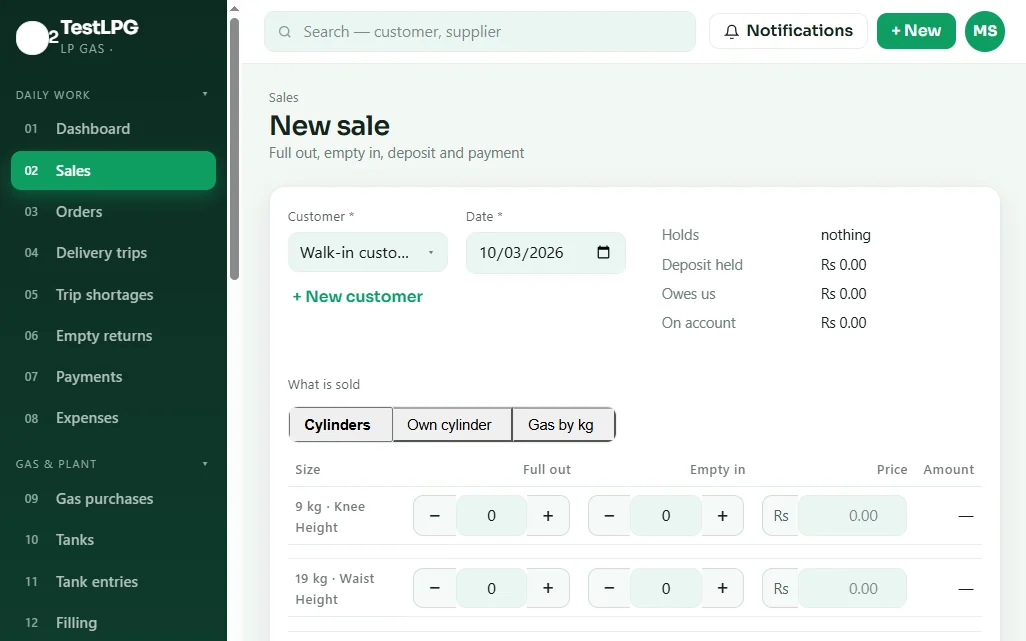
Sell by cylinder size, the way your counter already works. The customer's cylinders and balance sit beside the sale, so nothing is missed.
- Sale screen built around cylinder sizes: Full out, Empty in, price, total.
- Refill, full cylinder, customer's own cylinder, or gas by the kilogram.
- When a customer keeps a cylinder: deposit paid, lent, or bought. Each one is recorded.
- Prices come from your price lists. You see a warning if a price goes above the maximum per kg you set.
- Orders by phone, WhatsApp or walk-in; delivered orders become invoices.
- Delivery trips: load the vehicle, deliver, return, and settle cylinders and cash at the end of the day.
- Invoice as A4 PDF and as an 80 mm till slip. Send the summary on WhatsApp.
Cylinders
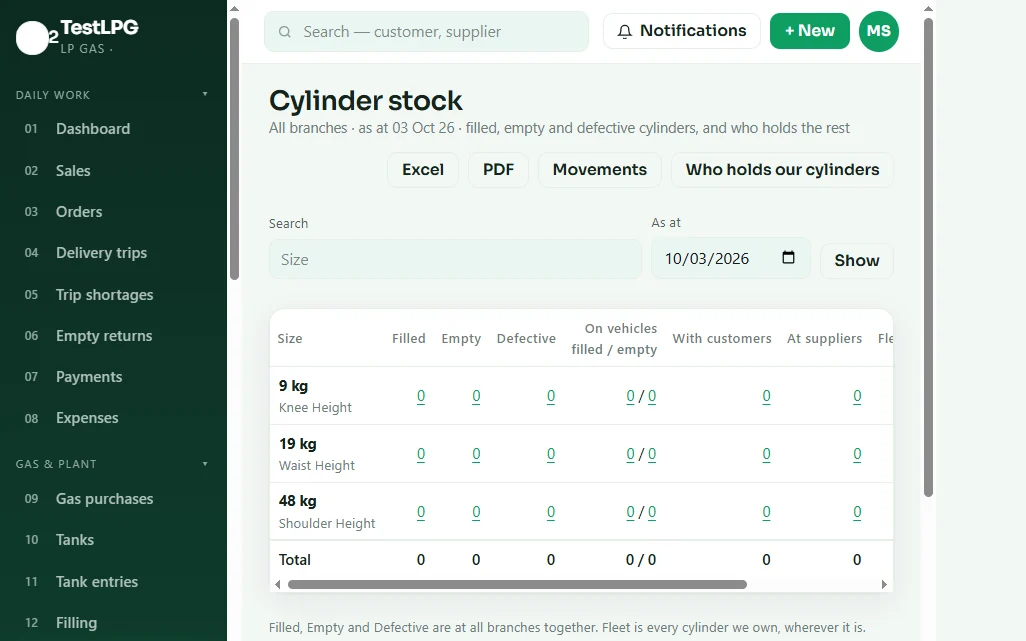
A cylinder often costs more than the gas inside it. Empty cylinder tracking and cylinder deposit tracking show where each one is and who has it.
- Stock by size and by state: filled, empty, defective, at each place and on each vehicle.
- Who holds your cylinders: every customer and supplier, by size, and for how long (0–30, 31–60, 61–90, over 90 days).
- A cylinder statement per customer, as a PDF with a signature line, or sent on WhatsApp.
- Deposits taken and refunded, tracked per customer.
- New cylinders bought, or filled cylinders swapped with a wholesaler for your empties.
- Fleet check: the count from the books and the count by place must agree.
- Testing, write-offs and physical stock counts.
Gas and the filling plant
Follow the gas from the tanker to the cylinder. Any gain or loss shows the same day, in kilograms and in per cent.
- Bulk gas received into a tank, with weighbridge weights, and the difference from the supplier's paper.
- Cost of gas worked out for you on every delivery: landed cost per kg and your average cost.
- Daily tank readings, compared with the books: gain or loss today, over 7 days and this month.
- Move gas between tanks, or record a gain or loss with its reason.
- Filling sheet per shift: cylinders filled, gas used, filling loss.
Tank reading with gain / loss
Money
Money in and money out, in plain words. Every payment is set against the invoices it pays, so you always know who still owes what.
- Money received from customers and paid to suppliers, set against invoices oldest first. The rest stays on account.
- A credit limit and credit days per customer, and a customer can be put on hold.
- Receipts as A4 or an 80 mm slip, and sent on WhatsApp.
- Cash and bank accounts, transfers and a daily cash count.
- Expenses by category, vehicle or employee.
- Loans taken and given, with instalments and balances.
Trip settlement
People
Customers, suppliers and staff in one place. Each customer keeps their own prices and limits.
- Customers: distributors, dealers, businesses, households, in groups, each with its own price list and credit limit.
- Each customer's page shows the cylinders they hold, what they owe, the deposit held, the credit left, and a statement.
- Suppliers: what they supply, what you owe them, and the cylinders of yours they hold.
- Employees, attendance, monthly salary sheet, advances and payslips.
Customer page: cylinders held
Vehicles
Know what each vehicle costs you to run. Get a reminder before a document runs out.
- Vehicle register, fuel log, services and repairs.
- Cost per kilometre.
- Reminders before a licence, permit or certificate expires, for vehicles, drivers and the plant.
Reminders
Reports and control
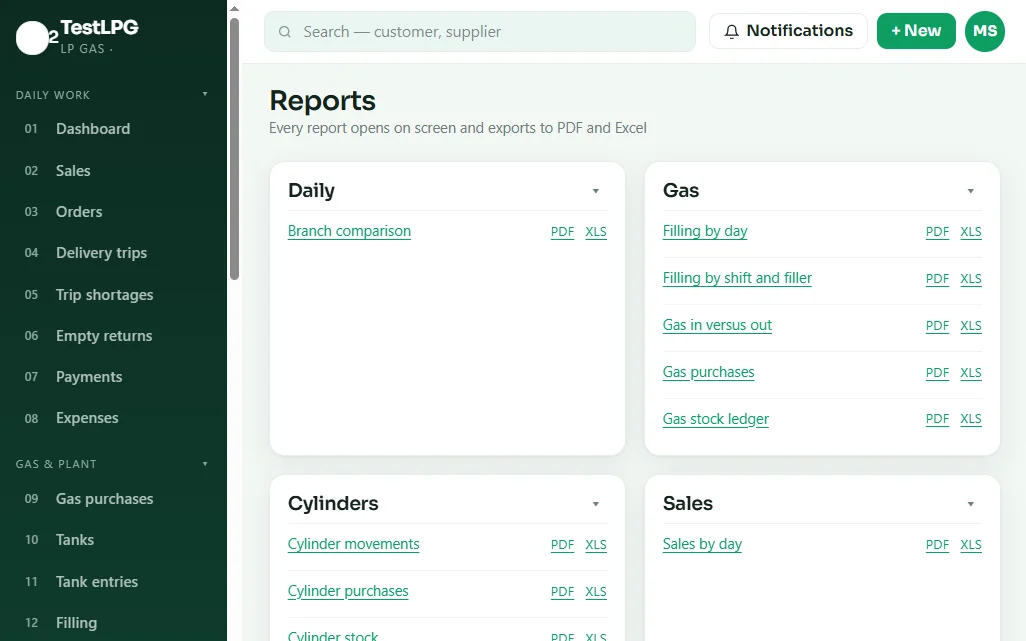
Every number in the system, ready as a report. You decide who sees what.
- Daily summary, gas in versus gas out, gas stock, cylinder stock and movements, cylinders held by customers, sales by day, gas and cylinder purchases, customer statements, what is owed (receivables and payables), trips, vehicle costs, payroll, loans, expenses, cash book, VAT, profit and loss.
- Every report and every list as PDF and Excel.
- Users and roles, such as owner, manager, cashier, plant, dispatch and accounts: each person sees only their own work.
- Audit trail: who changed what, and when. Documents are cancelled, never deleted.
See these screens with your own numbers.
We will set up your cylinder sizes and prices and walk you through a normal day.